HIGHLIGHTS

Thursday, August 14, 2008

San Cristobal - sea lions


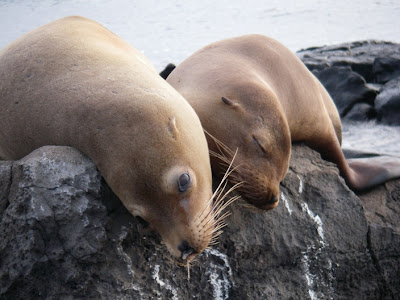
Mom and pup laying on the lava rocks - they seem to plop down into any position and relax all day.

SEA LIONS
There are sea lion colonies all over the place in San Cristobal! Right by the docks at the waterfront, along the beaches, and at "La Loberia" - it is a great show. They are a relative of the California sea lion, but slightly smaller, and really playful in the water (they love to swim within inches of you). On the beach, they are very relaxed about human presence - except male bulls taking care of their harem. They guard their territory and chase other males with their barks and attacks. Occasionally they will also mistakenly chase Australians out of the water, I noticed.
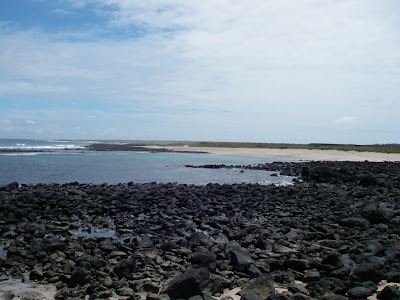

La Lobería - the "wolf-place", sort of translated - is where sea lion colonies congregate. Every island seems to have at least one. Sea lions are "lobos marinos" in spanish, or sea wolves.
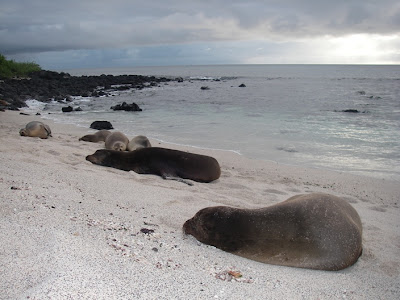

The colony at Punta Carola - They can smell really foul - apparently in other seasons their stench moderates a bit.
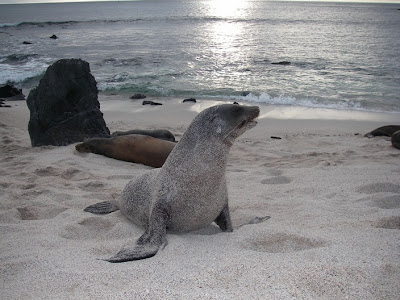

A sandy sea lion huffing and puffing. I had to walk a good distance from the bull´s harem in order to be allowed in the water.

From Galapagos Online:
(the site also describes the Fur Seal)
Adult males known as Bulls are the head of the Colony, and can grow to be up to 7 ft (2 m) in length and 800 lbs (363 kg). As males grow larger they fight to win dominance for a territory including a Harem of between 5 and 25 Cows. Each Cow in the Harem has a single Pup born a year after conception. The Pups have a strong bond with their mother. The Cow will nurture a Pup for up to three years. In that time the Cow and the Pup will recognize each other's bark from the rest of the Colony. When the Pup is 2 - 3 weeks old the Cow will mate again.


Tuesday, August 12, 2008

San Cristobal arrival


View Larger Map

LEAVING SANTA CRUZ
I felt a distinct sense of relief. I was starting to feel a bit claustrophobic in Santa Cruz island - the onshore wind, rocky shore, cramped town. The boat dock was total chaos: 4 boats leaving for 2 islands, at 2pm everyday, down a tiny gangway. Through the confusion I heard the name of the boat, "Sunfish", and joined the other 2o passengers on a rough 3 hour crossing. (August and September are the roughest months, because the southeast tradewind is blowing non-stop.)


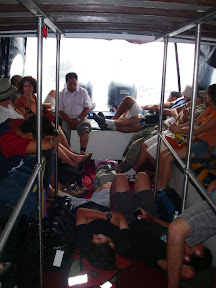
The Israeli backpackers were lucky to sleep on the floor - possibly the most comfortable place on the "Sunfish".

THE WATERFRONT
Puerto Baquerizo, the town in San Cristobal and capital of the Galapagos province, was gloomy and drizzly when we arrived. Still, the harbor was protected and calm, with a gentle offshore breeze, an impressive "malecon" (the waterfront) spanning several hundred yards, made of wood. I was instantly at ease.


Puerto Baquerizo in San Cristobal is calmer and more welcoming than neighboring Puerto Ayora in Santa Cruz island.


This time of year, it is usually cloudy during the day, but the sun will peek from under the clouds just before sunset.

ROOM UP ON THE HILL
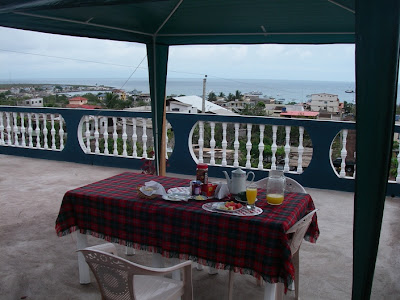
After 20 minutes walking around town looking for affordable accomodation, a taxi driver told me about a $10/night room at someone´s house up on the hill. The newly built rooms on the third story far exceeded my expectations. I was greeted to an incredible view of the bay and a lefthander peeling in the distance. Landlady Celeste showed me around, and I immediately settled into my new favorite place, the large patio.


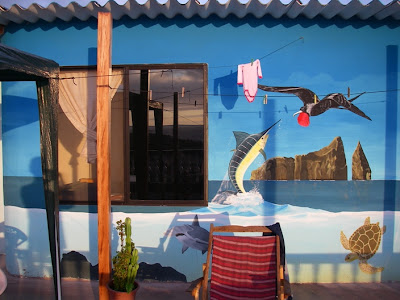
Mural on my wall facing the patio. The rock with the pointed crevace on the right is Leon Dormido, the famous diving spot to see sharks. The male frigate bird is the one on the top right, with a red throat sac to attract females.


The gourmet breakfast was $3 extra - fruit, eggs, pancakes or french toast, and plenty of fresh juice.

Monday, July 21, 2008

Galapagos - Las Grietas y Garrapatero


The salt marsh and the bar enroute Las Grietas.

On Friday afternoon I headed to "Las Grietas", by first crossing to the bay with the $.60 water taxi, and then walking past the mangroves over volcanic rock to a deep grotto of rock. The deep clear water had an occasional large snapper swimming through it, which would vanish once someone jumped from the 40-80ft rock ledges into the water below. I met up again with a tour guide called Darwin, who is a great guy - we played soccer at Tortuga Bay together last weekend. On the way back I started talking to two other people, Shaun and Alejandra, who were also strangers, and we ended up having impromptu adventures. These started by having a caipirinha at the bar and then being invited by the bar owner into his house - an expat with a crazy sense of humor. His humble abode had the most impressive view of the moonrise over the water and we danced with family for a few hours and tried homebrewed vodka, before he ferried us back to town in his own skiff.


Pre-jump adrenaline.

After a night of dancing in the town's one and only club, Bongo's, Shaun and I decided to go camping at Garrapatero. Shaun was an investment banker on Wallstreet just 6 months ago, but he "capitalized" on the real estate downturn and became a happy go-lucky vagabond cruising South America. Everyone told him it was impossible to get a cargo ship to the Galapagos these days - but after 1 weeks of pleading he managed to get a spot above the banana crates, where ants bit his lip. He said it was pretty aweful, second only to spending 2 weeks in the Bolivian jungle with a native guide having a "real Amazon experience" - eating worms, having no mosquito nets, hunting with a bow and arrow. I was proud of Shaun.


Playa de Garrapatero and surroundings.

Playa de Garrapatero was a scenic beach 30 minutes by taxi from the town. It was full of people on tour when we arrived but they all left. We were an absolute hit with the big crowd of Ecuadorian schoolteachers who were here on a work vacation - they wanted to take pictures with us and our tent, at least 20 times. We were sad that the flamingos weren't around in the lagoon area; but we had an excellent time regardless.


A crowd of Ecuadorian schoolteachers overtook our campsite.


Saturday, July 19, 2008

Galapagos - working with CI


I set up my office in the outside patio - nice and cool with the breeze.

I am assisting the people at the Conservation International (CI) office in Galapagos with two projects. The first is a research vessel, actually a "barge" called Tiburon Martillo (hammerhead shark in spanish) which will be posted in the Wolf and Darwin Islands, a remote part of the Galapagos archipelago.

These islands are just big rocks in the middle of the ocean, but there's a lot going on: they are a major breeding ground for hammerhead and whale sharks, and have some of the last remaining coral in the Galapagos, after 90% of it was wiped out by the last few El Nino events. More tour operators are coming to the area as the SCUBA diving is world-class, and some consider it the best in the world in terms of watching megafauna. The islands are also a haven for fishing - legal and illegal. The mafia-like illegal shark fin industry supplying the Asian market has exploded in the Pacific and there are even boats coming from Costa Rica to exploit the sharks, which in turn is destroying the ecosystem, which depends on sharks for top-down control.


The fisherman's wharf in the Puerto Ayora waterfront, where they sell fillets of "pescado blanco" for $2/lb.

The "Tiburon Martillo" barge will stay in this isolated area, with a crew of 7 or 8, to conduct scientific research, monitor, and enforce regulations. Its a major endeavor, logistically and financially, and my role is to figure out how to better integrate the private sector (tourism and fishing) with this project.

The second project CI is doing here is the "Zero Anchors" initiative, which is trying to set up mooring balls along all the anchorages that are heavily visited by tourism boats. After you see the size of the boats at Puerto Ayora it is easy to understand why this is so important - 50 foot boats are dwarfed by several mini-cruise ships and mega-yachts that take tourists around to each of the islands every week. Their anchor and chain can clear 100 feet of whatever is on the seafloor, and more when the seas are rough. There are literally scrubbing clean the very habitat that the tourists are coming to see - hence the hope that they'll be able to use (and pay for) these mooring balls, instead of their anchoring equipment.

I'm excited about what I'll be doing, particularly since it's quite open ended - and I'm hoping that I can get on some of those boats...


View of the Puerto Ayora pier and anchorage from the top floor of the supermarket, Proinsular.

Monday, July 14, 2008

Mexico and Ecuador

In May this year, I received an Ambassadorial Scholarship from Rotary International to study and work in Central America during 2009-2010. Two Rotary Clubs sponsored my application: Santa Barbara Sunrise and Goleta Evening. What follows is my letter to them about my trip to Mexico and the first part of my trip to Ecuador.


Hi Gary, Harold, and Rotary friends,

I hope you're doing well this summer, and that the ash hasn't been too bad. I hope that the fires in Santa Barbara will soon be under control, if they aren't already.

I've been having an amazing time so far during my trip. First, I spent two weeks in Mexico, in the vicinity of Zihuatanejo (just north of Acalpuco, in the southern part of the mainland) doing research for my graduate thesis. The other 4 people in my group were also there, and we did several site visits to Playa Viva, which is the eco-resort that we are using as our case study. Our group is looking at examples of socially responsible investment in property, with a focus in the tourism industry in Mexico, and this could turn out to be a good role model for "green development".


Our first tour of the Playa Viva site was carried out impromptu by someone we met on the road: Canadian expat Bob, who has spent 30 years in the area and makes Aztec stone sculptures. The site is a mix of estuaries, palm trees, native vegetation, and sand dunes - it's really beautiful and full of animals - 85% of the land will remain preserved according to Playa Viva's plans. Canadian Bob took us to the turtle sanctuary, which Playa Viva helps support, and we watched newborn turtles scurry into the ocean. In days to come we also met with the architect, the permaculture specialist, and other community members.


Besides the turtle sanctuary, Playa Viva assists the community agriculture program in the area, which promotes organic farming practices; as well as the recycling program in the local township. The resort will be built with natural materials and will have on-site solar energy generation. Most impressively, they have an extensive restoration project to bring back the native vegetation and restore one of the lagoons which previous palm plantations had filled. In all, the development could actually improve the biodiversity of the region, and will hopefully bring positive benefits to the local community. We are now conducting background research on the project, which will be discussed in greater detail in our master's thesis. Although every development has impacts, and none can be perfect, it's still exciting to see that people are becoming increasingly conscientious about environmental and social issues these days.


Besides working on our project, we also spent plenty time of at the beach - the days were warm with a nice amount of cloud cover, and regular thunderstorms would cool down the temperature. Every other night there were lightning storms which we watched in the distance or hunkered down as they went over us. Even so, we often used fans or A/C to stay cool at night. During the days, we drove north to different surfspots, where we'd rent boards and get waves; or we'd drive south into Zihuatanejo itself (about 30 minutes) to get a bite to eat. Often, we just stayed at home and enjoying the ocean right in front, since we were fortunate to be in a beautiful house on the beach - courtesy of the family of one of our team members.


Crossing the channel from Baltra to Santa Cruz Island, Galapagos
After my two weeks finished, I had a full day of travel to arrive in Guayaquil, the second largest city in Ecuador, which lies on the southern part of the coast. Although it seemed fairly peaceful, a number of people advised me to be careful in Guayaquil - the folks from the organization I will be interning with organized a homestay with a family. It was quite nice, their son showed me around the town and we had some good Ecuadorian meals - plantains, beans, roast beef, etc. I spent two night there, and then got the morning flight to the Galapagos islands.

At my school (Bren School of Environmental Science and Management, at UCSB), all the master's students need to complete a summer internship. I was lucky enough (and worked hard for it!) to find an internship in the Galapagos with Conservation International, an organization whose mission is to support biodiversity of flora and fauna around the world. My work will likely be in the financing and communication documents to support a research vessel based in the Wolf and Darwin Islands, a remote part of the archipelago that is a breeding ground for hammerhead sharks and whale sharks.

The fishing port at Puerto Ayora, Santa Cruz Island

I arrived on Saturday, and the plane landed on the small island of Baltra; we then took a shuttle to a ferry, in order to cross the channel and arrive in the island of Santa Cruz; at which stage we took a taxi (they are all white pickup trucks here) which took me to the main town of Puerto Ayora, and finally to my accommodations at the Charles Darwin Foundation, where I am being housed. It is located in the outskirts of town, right on the water's edge, with lush vegetation all around. Walking around, one must be careful not to step on the ubiquitous marine iguanas; this is especially challenging as they like to flounder on the black lava rocks by the beach, and camouflage perfectly so that it looks as if "the rock starts moving".

Marine Iguana that likes to hang around near the "comedor".

At night in the waxing moon I walked about the property and watched the giant tortoises asleep - they're like big mounds. On Sunday my new Ecuadorian friends, who are volunteering at the Foundation, took me to the long sandy beach west of town, which also has a nice clear lagoon. The weather has been cloudy, this being the season for such conditions, but it makes things cool and comfortable even though we're right under the line of the Equator. The folks from Conservation International lent me a bicycle and I've been exploring the town, which is larger than I expected, but small enough that we often need to wait one week for "special supplies" like copies of my office keys.

I'll be here for a month and a half, after which I'll travel around the islands and the Ecuadorian mainland; and finally return to California around the 16th of September. I'll send other updates in the weeks to come.

Have a great summer and we'll talk soon!
Best,

Kristian
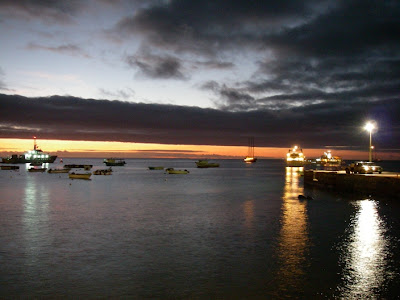
Nighttime on the waterfront of Puerto Ayora, Galapagos.

Wednesday, June 25, 2008

Anchoring for 10 weeks

Since I would be leaving the US for 2.5 months - two weeks in Mexico and 8 weeks in Ecuador - I wanted to make sure the boat would be safe. Many preparations were taken, such as making sure the bilge pump was working, the solar panel was charging the batteries properly, the skiff was ontop of the sailboat securely, the bow gear and cleats would withstand the stress of time and potential gales.

View of the Black Pearl as I paddled to the wharf Furthest out at East Beach, but still close enough so friends would be able to check on the boat, I dropped the 33lb Bruce anchor and 250 feet of chain - which is a fair amount for 40 feet of water during the summer. In case the harbor patrol had to tow my boat (knock on wood) and drop the anchor rode overboard, I left a few buoys handy. With surfboard and waterproof satchel in hand I jumped in the water and paddled back to the wharf, much to the confusion of the fishermen at the pier.


Early in my trip there was a scare. During the first week I was in Mexico, I had a bad dream about the boat (it disappeared!) and the next day I got a voicemail from the harbor patrol: "We got a report that your boat may be dragging, and you should come down here to move it." After a few phone calls, my friend checked out the situation and discovered that a powerboat had anchored right next to me; and had a bunch of anchor line hence was swinging around into other boats during calm times. They were there to watch the July 4th fireworks, and then left afterwards. Last I heard, my boat hasn't moved much, and continues soundly to this day, while I travel in South America.

Saturday, June 21, 2008

Day 4 of the Trip


The situation was becoming a bit interesting, for 3 reasons: 1. we needed to return tonight as the crew had to return to their jobs; 2. the wind wasn't picking up; and 3. our gas was probably insufficient to get us all the way back across the channel. As it were, several boats decided to visit Potato Harbor this day, I suppose since it was so calm, and we asked if they wouldn't mind spotting us some petrol.

A kind couple from Oxnard gave us a gallon, and the rowdy follks from "Tipsea" also let us syphon a gallon from their outboard. Thanks to these friendly boaters we'd make it back on fossil fuel alone, if need be. As it turned out, we didn't need it, but... it's better safe than sorry. Since I'm really not a fan of using gas engines (hence the reason we only brought 4 gallons on this trip, which wasn't enough given the calm conditions) the experience reinforced my hopes of one day getting an electric inboard and a more robust solar system and battery bank.


Getting gas from Tipsea - arrghh, the bounty!

So shallow was the anchorage that I dove for the stern anchor (20lb Bruce) in 10 feet of water and walked it along the seafloor back to the boat (nevermind the 100ft of 1/4in chain). We motored into the channel, expecting total calm, but happily felt the first airs after an hour, and soon had 10 knots of wind on our beam. The Pearl was flying with her recently scrubbed hull, doing over 5 knots in the blissfully smooth conditions for a full 3 hours. The final few miles were back on engine mode, which gave us enough time to wash down the decks with buckets and scrubbers; secure all the sails and gear; and make the boat more beautiful than when she left.


The boat was sailing sweet and fast under helmsman Owen.


Enjoying post-voyage meal at the Endless Summer Cafe in the harbor.

Friday, June 20, 2008

Day 3 of the Trip

June '08 Trip Santa Cruz Island


The wind wasn't even threatening to make an appearance; yet we had the itch to move so we weighed anchor around 1pm and motored in glassy seas with the silver tarp half-sheltering us from the scorching sun. We hugged the coast chugging along at 3 knots to save gas, and checked China Harbor to see if there were any waves; there were none. On we motored to Potato Harbor, which is a scenic potato shaped cove, quite large but rather exposed to the prevailing North West swell and wind. However this being an ultra calm day we tried our luck there.


The others hiked off to watch the sunset from the top of the mountain while I hunkered down and watched the boat, increasingly concerned as a regular windswell emerged from the NW. Was this an indication of a stronger wind ready to howl, or the fickle night sweats of a dark ocean? We had been a bit arrogant about anchoring so close the rocks and now I regretted it. The worry subsided though, as the wind remained a steady but light breeze, pitching the boat considerably like a seesaw, but thanks to the bow & stern anchor setup we were not rolling at all, and were able to sleep fine.


Later, I was to find out that my friend was aboard his 38 foot Islander sailboat hanging on for dear life as a strong wind was sweeping down the canyons at Smuggler's Cove, on the other side of the island. How strange - we were in the windward side of the island, and experienced only shifty light airs, while my friend was on the leeward side, protected one would imagine, but getting blown by offshore winds. This is apparently a result of the Venturi Effect that increases the velocity of the wind as it travels up the mountain and then blows down the other side.


Anchored at Potato Harbor

Thursday, June 19, 2008

Day 2 of the Trip

June '08 Trip Santa Cruz Island

The Nature Conservancy owns about 76% of Santa Cruz Island, which is restricted to no public access. Their efforts to preserve and restore the land range from native species restoration to pig eradication campaigns to support the island fox populations. Access to most of the island's coves is only possible by boat, which is how we made it into Fry's Harbor.


The experience of being anchored in a remote cove is unlike any other I know. The lack of civilization, the calm water, no distractions from phones, internet, and chores, lends to a near total state of relaxation. I say near total, because for the captain at least there is always an undercurrent of anxiety, which often lies unmanifested, but is ready to be triggered at the hint of any problem.

The dragging anchor is the primary possibility for stress - if the wind picks up and/or the anchor is fouled (not properly set) the rocks are awfully close by. But there is also a personal satisfaction drawn from the responsibility of smart anchoring and the edginess of being on your feet at all times.


As for the crew, the total relaxation was multiplied by the heat wave that was overtaking the California coastline during this summer solstice weekend - 85 degrees on the coast, not a breath of wind even in the "Windy Lane". The water was crystal clear, not too cold (63 degrees or so), we donned our wetsuits and went diving. Swimming through the kelp beds is a show of filtered light, tunnelling through the plant material that rises 40 feet off the ocean floor; and when we are free-diving, to look up at the water surface twinkling above and look for an opening in the kelp is a veritable joy.

A note on kelp: it is the fastest growing plant at a max of 2 feet per day (in contrast to shabby performance of bamboo, corn, and kudzu, which grow up to 1 foot per day), supporting a productive ecosystem of fish and crustaceans by affording hidding spots from predators and providing plenty of food. Only because of the cold water from the upwelling of nutrients does kelp grow, so even though it's located in chilly waters with the right wetsuit and attitude the experience is well worth it.


In the spirit of Two Years Before the Mast, I recruited my willing crewmates to do some maintenance work on the boat after our leisurely morning. That book taught me two things: 1. to be thankful that I have my own boat, despite its trials and tribulations, there is nobody who will slave-drive me; and 2. that the pattern of a vessel disintegrating at sea and being repaired in the harbor need not be the case, that through diligent maintenance it can actually be more beautiful when it returns to port.

So we scrapped the hull free of barnacles for 45 minutes each, and sanded and oiled the teak trim of the toerails and handholds; and in 2 hours accomplished what would have taken 8 hours for me to do in port. All the while, we had big grins in our faces because we knew a nice dip in clean water was seconds away.