HIGHLIGHTS

Tuesday, September 02, 2008

San Cristobal - scenes from the town


San Cristobal is to the right of Santa Cruz, centered, 2.5 hours by boat.


The waterfront road at Puerto Baquerizo.


August 10th was the celebration of Ecuador's independence, and all government workers (at hospitals, school, etc.) were mandated to be part of the parade. There had been band practice with loud drums nearly everyday, particularly during siesta time. This evened out the noise spectrum - from the 6am blarring radio at the mechanic shop, to the dogs and chickens making a racket all night, to the taxi horns during the day. Noise seems to be a part of life here.


A week before independece day, the mayor put on a concert for the locals, to celebrate the town.


Yan the surfer from Paris - the ozzies taught him hand motions to mimmick getting barreled on a wave, and he practiced these in the middle of the street.


The beach and the ozzies from Melbourne, Warren and Eric.


Enroute back to Santa Cruz island - August and September are the windy months and the channel crossings are the roughest.

Diving - Leon Dormido


This was my first dive in the Galapagos, off San Cristobal Island - a monolithic rock 1 mile offshore, called Leon Dormido or Kicker Rock, with a split down the middle. The split has produced a channel with moderate currents that attracts sharks and rays, about 20 meters deep (60 feet). This was my 6th dive, the first after finishing the SCUBA certification back in California this May.


There was a school of 20+ Galapagos sharks, 1-2 m (3-6ft), swimming through the channel as we dove - they went right up near the surface and paid the snorklers a visit! A school of 8 or 10 spotted eagle rays, as wide as the sharks were long, also swam by.


Shot of a green sea turtle with my "waterproof" Pentax before it leaked water and broke. The water was too turbid to see hammerheads, which cruise by the rock walls at 80 feet. Our guide explained that the water is supposed to be colder this time of year (it's 22C or 73F); since the cold and warm currents are still mixing the water is more cloudy than usual.


There was a family from Cuenca on the right (old colonial town in Ecuador), a spanish diver, an american diver, myself, and the two neighboring ozzies.

San Cristobal - El Junco, Galapaguera


Climbing the volcano in San Cristobal - "El Junco". The inactive volcano crater is the largest fresh water lake in the Galapagos and provides the town with its drinking water, which is much better than the other towns in the archipelago. I walked its circumference in 30 minutes.


After considerable effort by the national park to remove the invasive species of guava trees and blackberry bushes, which have overwhelmed the islands and destroyed tortoise habitat, the area around the volcano is back to native vegetation. It's ironic that fruit can do so much damage!


From Wikipedia:
The shape of the carapace of some subspecies of the tortoises is said to have reminded the early Spanish explorers of a kind of saddle they called a "galápago," and for these saddle-shaped tortoises they named the archipelago. Up to 250,000 tortoises inhabited the islands when they were discovered. Today only about 15,000 are left.

A noted visitor to the archipelago, naturalist Charles Darwin, remarked "These animals grow to an immense size ... several so large that it required six or eight men to lift them from the ground." [3] This is due to the phenomenon of island gigantism whereby in the absence of natural predation, the largest tortoises had a survival advantage and no disadvantage in fleeing or fending off predators.


This sign at the Galapaguera shows how they brought tortoises in 2002 from their natural habitat in the far north of the island to Puerto Baquerizo (by boat) and then to the breeding center at Cerro Colorado (by truck). The breeding program run by the Charles Darwin Foundation and the National Park has succesfully re-introduced hundreds of captive-bred juveniles back into the wild, helping tortoise populations to recover.


Puerto Chino, at the end of the road.

Sunday, August 24, 2008

San Cristobal - surfing


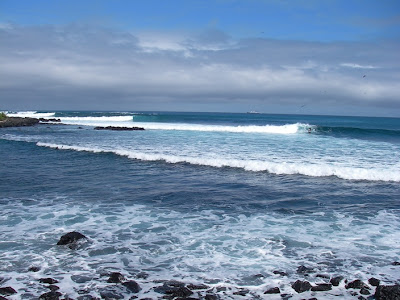
First look at Tongo Reef, two guys out.

I was deceived from the view from my house, at the top of the hill - it looked like the surf was flat. So on the first day I walked out to Lobería, which is the sea wolf colony just past the airport, and picks up the most south swell. It is a heavy reefbreak just outside a pretty lagoon - unfortunately, the trade wind is blowing onshore at this spot, between June-Nov, 24 hours per day.

The following day, I walked out past the naval base to check out Tongo Reef, not expecting much; El Canon, the indicator spot which we can see from town, looked tiny. After the 25 minute walk I arrived at Tongo - it was overhead and consistent! I galloped back to town on my havaiiana sandals, scouted out a $10 rental board, and rushed to Tongo, where I had two excellent and redeeming afternoon sessions, on my own.

They were long lefthanders, tame but enjoyable, and the wildlife was unreal: a bunch of sea turtles swimming around, blue-footed boobies divebombing for fish, sea lions messing around. Sadly, as I went through the "minefield" of lava rocks on my way to shore, I snapped a fin off, which ended up costing me $20 for a replacement, out here in this isolated and costly island.
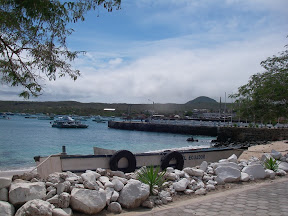
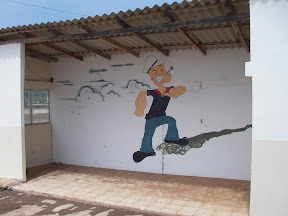
The view from the naval base enroute to Tongo. Popeye rules.
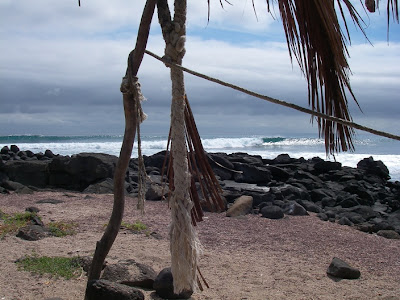

The outside and inside sections linking up. The water was 68-70 degrees fahrenheit.
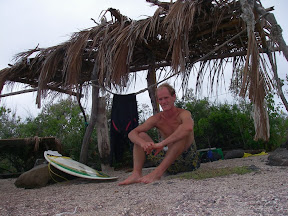
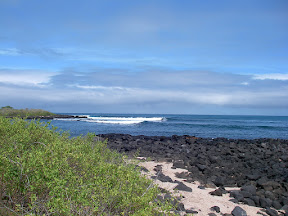

The Cabana and the rental board. I ended up spending $60 on surfboard rentals all together, more cost-effective than bringing my own? Less hassle, at least...

While I was in Cristobal 2 weeks, there were 3 smallish swells, never much bigger than a foot overhead, and flat for days on end. People didn´t seem particularly surprised by this, except for me. The roaring 40s are pouring with storms, and everywhere else is pumping: Peru, Tahiti, Australia. So why is there so little swell in the Galapagos this time of year? Or maybe I caught a slow period and it usually pumps...

Everyone raves about the waves during the other season - November thru April - as the north swell spots are firing, the wind is calm, AND there is south swell. Go figure. Clearly, that´s the best time of year. But, I certainly got my money´s worth in the perfect playground of Tongo Reef, for seven days in the water.
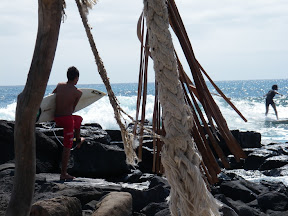
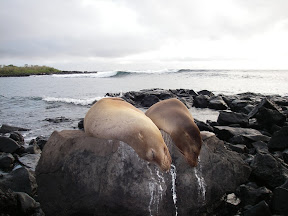

Local kids were really good, even with just 2 years experience. They would sometimes wait for each other on the beach to share the board, as they likely co-owned the expensive tabla. The sea lions look like they´re slobbering white stuff, but it´s just an illusion.
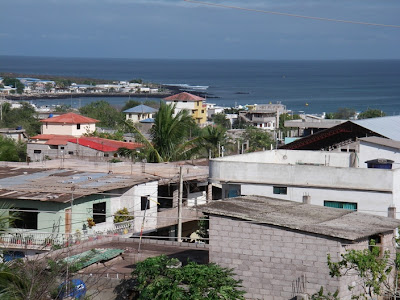


The view of "El Canon" from Casa de Celeste, where I was staying. It never got big enough to surf it. There is, in fact, a big naval canon in front of the point.
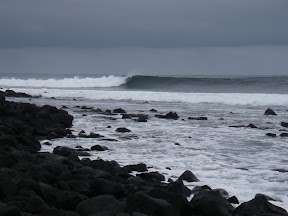
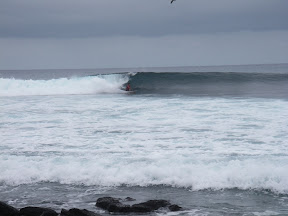

Just past the actual point at Tongo is another section, called the "Peak" - I surfed this as it was less crowded and more powerful. Disadvantage: it is littered with rocks to dodge and weave through. No damages to body or equipment, I´m happy to report.

Tuesday, August 19, 2008

San Cristobal - sailors

Daniel the Czech sailor aboard his steel cutter, "Waterbird".
(Photo courtesy Mysticsail, thanks guys!)

As San Cristobal has a much nicer anchorage than Santa Cruz (offshore breeze, no swell), most of the cruising sailors stop by here enroute the Marquesas, usually coming from Panama. I met Daniel, who had sailed from Europe to the Carribbean, spent a year or two, and was now on a mission to go to Antarctica (after the southern winter is over, to be sure). With just a masher and a whisk, he was able to mush together a fantastic banana smoothie aboard his boat. He was stoked because he met the banana farmer, and got to ride in the pickup to the plantation, and choose a gargantuan lot of bananas for his trip westward.
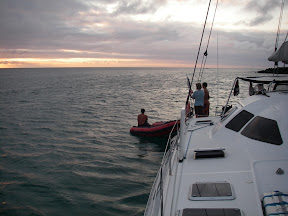
If you look really close, in the center, you can see the sails of the "Waterbird" raised, leaving the harbor to follow the sunset.

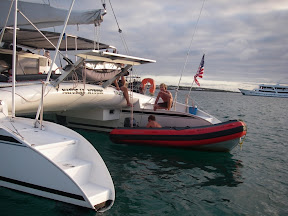
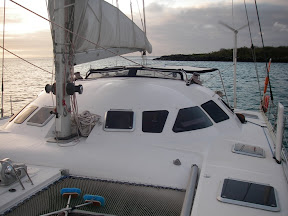
Whereas Daniel was solo, the folks aboard the "Natural Mystic" were having an absolute party. Led by 30-some year old Captain Kyber from Santa Barbara (of all places!), and the crew consisting of Khalil the Kiwi, Dizzy the Ozzie, and Ben from the east coast, these fellas were living it up - aboard a 55ft almost-new catamaran, a super-fast dinghy surf mobile, and a really good attitude. All the ladies in town wanted to meet them. They were anchored nearby Playa Man, the town beach, so I´d swim out there every so often, to froth over the boat. Like all boat owners, they did their share of maintenance work, dealing with immigration officials, and debating whether they should leave or wait for that swell that was coming in a few days... read about their travels here.


Monday, August 18, 2008

San Cristobal - marine iguanas


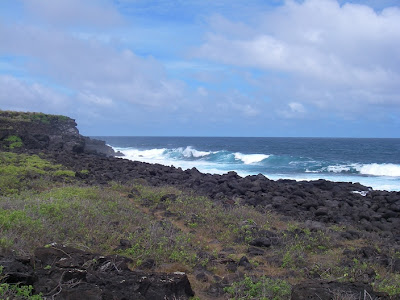
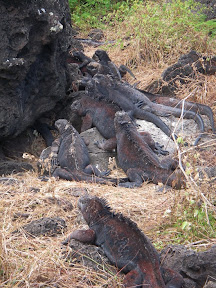
Prime marine iguana real estate just past La Lobería, San Cristobal Island.

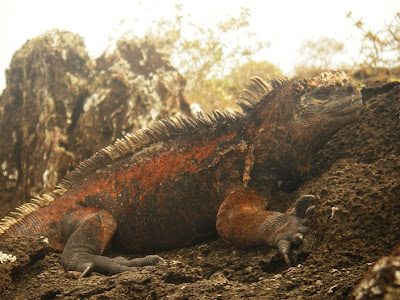
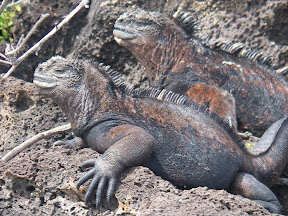
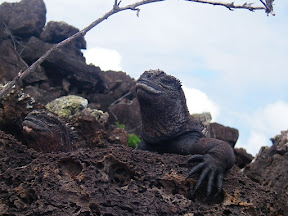
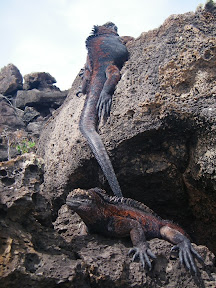
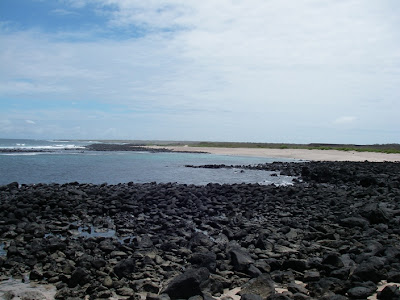
Past "La Lobería" is a stretch of black lava rocks with several families of marine iguanas. All morning they rest motionless, lounging on the rocks, calmly collecting the sun´s rays. When they are warm enough, they slither into the ocean and go find some algae and seaweed to eat. You can approach to watch close up within 2-3 feet of them. They look like wise old men, or mini-dragons, with their eternally serene demeanor. Marine iguanas are relaxing to watch, and even more so, to try and emulate.


At night, iguanas pile up together to maintain warmth - in the morning they look like a big happy family.

Marine iguanas can grow up to 1.3 meters - the largest ones live in Isabella and Fernandina Islands, on the western end of the archipelago. The biggest I´ve seen is about 0.8 meters. Incredibly, they can also change size - scientists discovered that during El Niño years, when their food source (marine algae) was reduced, the iguanas actually reduced in size about 20% by shrinking their vertebrae.

In the past, the iguana´s only predators were sharks and other large fish. They have not evolved to thwart their new predators - humans, dogs, and cats - so their populations are dropping. Galapagos Online has an anecdote describing how their instincts are ingrained:

"In the 19th century when Charles Darwin visited the islands he found thousands of Marine Iguanas living along the rocky shore. He picked one up and threw it into the ocean it instantly swam back to the shore. This was repeated several times and the Iguana continued to seek the safety of the shore when it could have easily swum off to escape Darwin."

Thursday, August 14, 2008

San Cristobal - sea lions


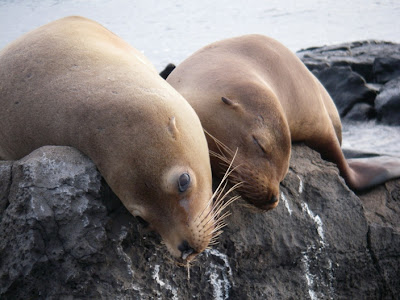
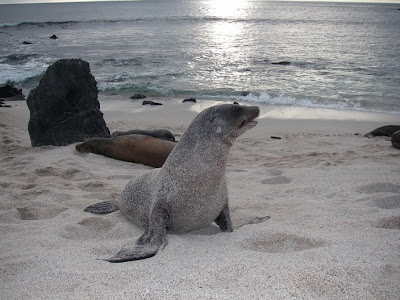
Mom and pup laying on the lava rocks - they seem to plop down into any position and relax all day.

SEA LIONS
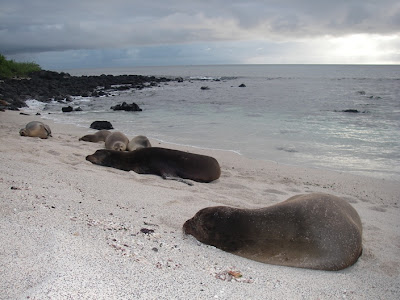
There are sea lion colonies all over the place in San Cristobal! Right by the docks at the waterfront, along the beaches, and at "La Loberia" - it is a great show. They are a relative of the California sea lion, but slightly smaller, and really playful in the water (they love to swim within inches of you). On the beach, they are very relaxed about human presence - except male bulls taking care of their harem. They guard their territory and chase other males with their barks and attacks. Occasionally they will also mistakenly chase Australians out of the water, I noticed.


La Lobería - the "wolf-place", sort of translated - is where sea lion colonies congregate. Every island seems to have at least one. Sea lions are "lobos marinos" in spanish, or sea wolves.


The colony at Punta Carola - They can smell really foul - apparently in other seasons their stench moderates a bit.


A sandy sea lion huffing and puffing. I had to walk a good distance from the bull´s harem in order to be allowed in the water.

From Galapagos Online:
(the site also describes the Fur Seal)
Adult males known as Bulls are the head of the Colony, and can grow to be up to 7 ft (2 m) in length and 800 lbs (363 kg). As males grow larger they fight to win dominance for a territory including a Harem of between 5 and 25 Cows. Each Cow in the Harem has a single Pup born a year after conception. The Pups have a strong bond with their mother. The Cow will nurture a Pup for up to three years. In that time the Cow and the Pup will recognize each other's bark from the rest of the Colony. When the Pup is 2 - 3 weeks old the Cow will mate again.


Tuesday, August 12, 2008

San Cristobal arrival


View Larger Map

LEAVING SANTA CRUZ
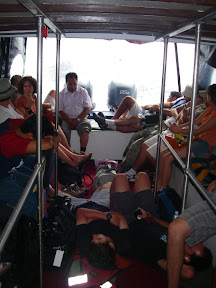
I felt a distinct sense of relief. I was starting to feel a bit claustrophobic in Santa Cruz island - the onshore wind, rocky shore, cramped town. The boat dock was total chaos: 4 boats leaving for 2 islands, at 2pm everyday, down a tiny gangway. Through the confusion I heard the name of the boat, "Sunfish", and joined the other 2o passengers on a rough 3 hour crossing. (August and September are the roughest months, because the southeast tradewind is blowing non-stop.)


The Israeli backpackers were lucky to sleep on the floor - possibly the most comfortable place on the "Sunfish".

THE WATERFRONT
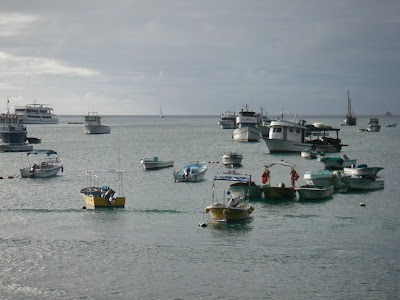
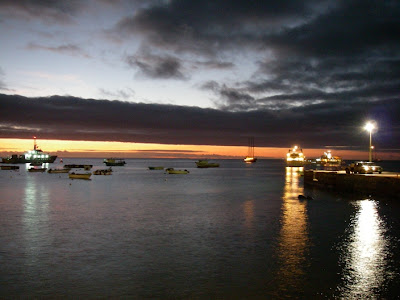
Puerto Baquerizo, the town in San Cristobal and capital of the Galapagos province, was gloomy and drizzly when we arrived. Still, the harbor was protected and calm, with a gentle offshore breeze, an impressive "malecon" (the waterfront) spanning several hundred yards, made of wood. I was instantly at ease.


Puerto Baquerizo in San Cristobal is calmer and more welcoming than neighboring Puerto Ayora in Santa Cruz island.


This time of year, it is usually cloudy during the day, but the sun will peek from under the clouds just before sunset.

ROOM UP ON THE HILL
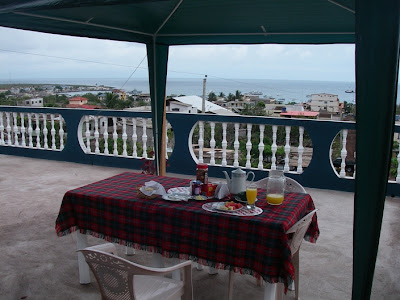
After 20 minutes walking around town looking for affordable accomodation, a taxi driver told me about a $10/night room at someone´s house up on the hill. The newly built rooms on the third story far exceeded my expectations. I was greeted to an incredible view of the bay and a lefthander peeling in the distance. Landlady Celeste showed me around, and I immediately settled into my new favorite place, the large patio.


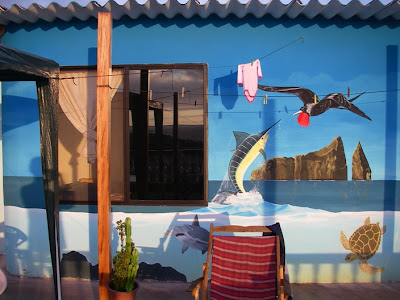
Mural on my wall facing the patio. The rock with the pointed crevace on the right is Leon Dormido, the famous diving spot to see sharks. The male frigate bird is the one on the top right, with a red throat sac to attract females.


The gourmet breakfast was $3 extra - fruit, eggs, pancakes or french toast, and plenty of fresh juice.